GNOMI Now Remembers: Introducing the Memory Layer
Most AI starts every conversation by forgetting you. We think that fundamentally limits how intelligent an agent can become.
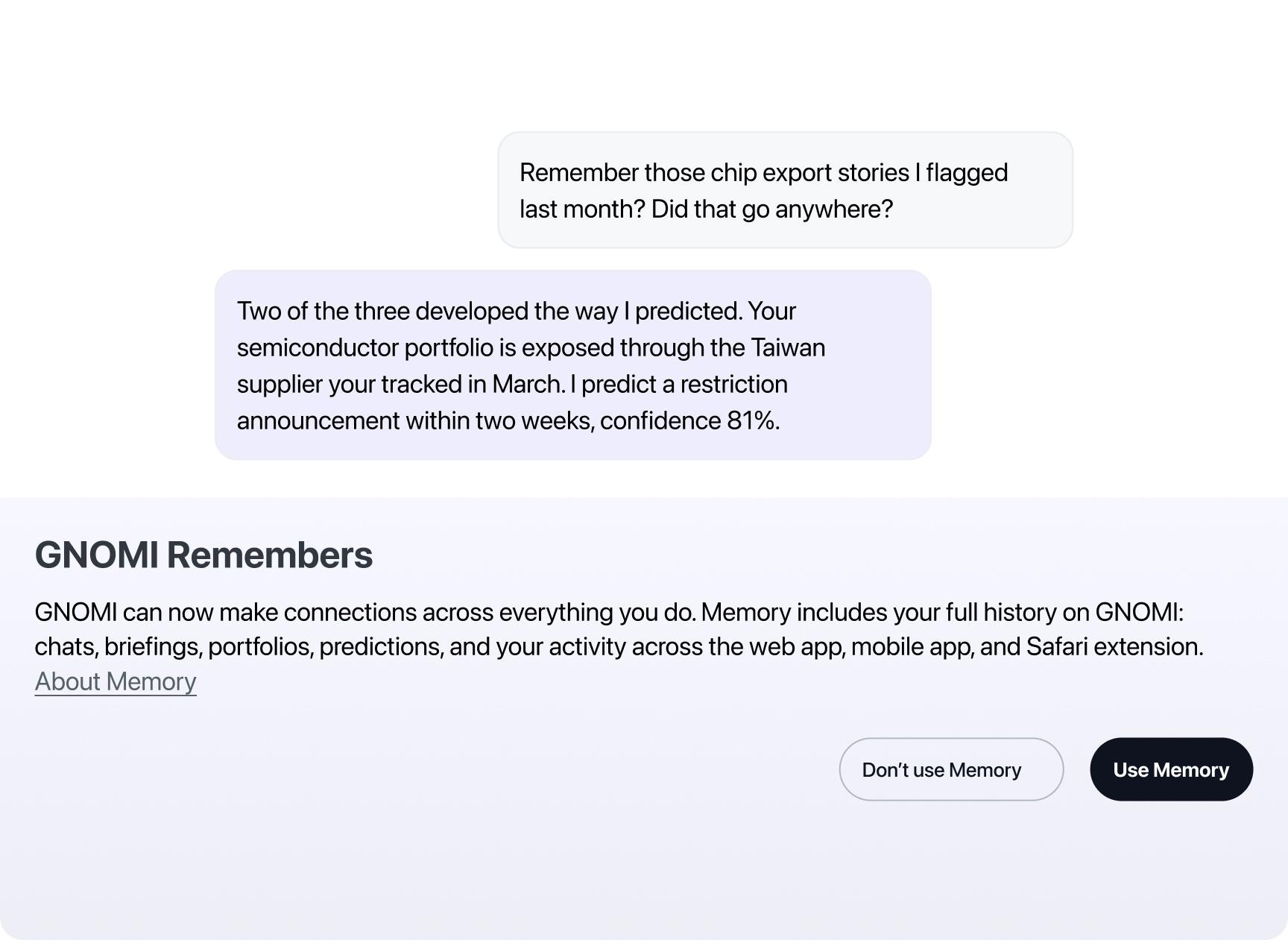
Today GNOMI is launching the Memory Layer, a persistent intelligence layer that lets GNOMI retain the context that matters to you and use it to make every future interaction more relevant. It goes beyond what you asked five seconds ago. It remembers what you care about, what you follow, how you prefer information delivered, what you have already investigated, and what may be worth exploring next. The longer you use GNOMI, the more useful it becomes.
Intelligence Should Build on Itself
News does not happen in isolated conversations, and neither do markets, companies, elections, geopolitical conflicts, or the technologies and decisions that surround them.
You might ask GNOMI about Nvidia today, European AI regulation tomorrow, and semiconductor policy a week from now. To a traditional chatbot, those look like three separate questions. In reality they form part of a larger information graph that is unique to you, and the Memory Layer gives the agent continuity across it.
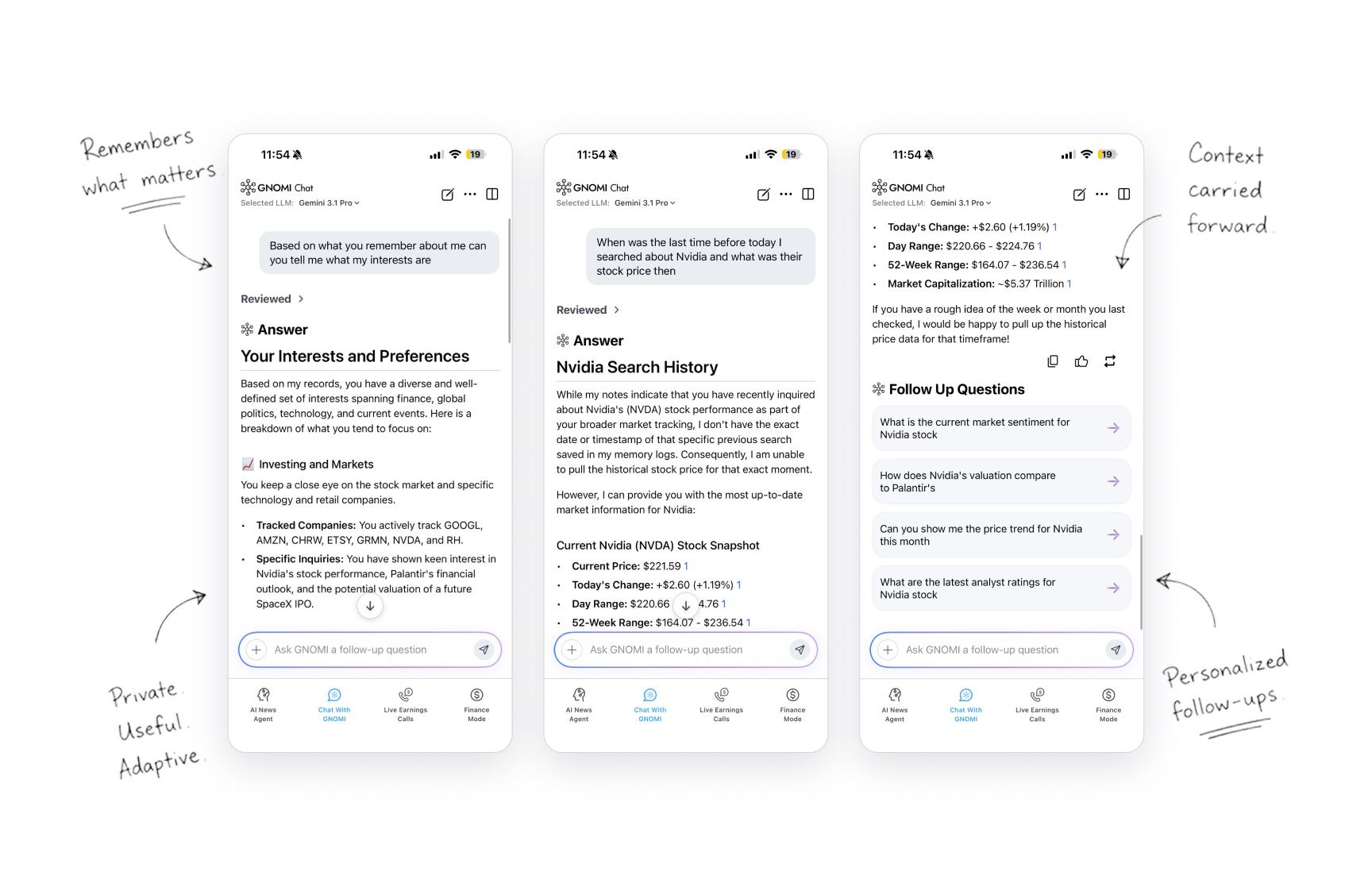
If you have been following Nvidia, GNOMI carries that context into any new development that affects the company. If you have been researching European AI regulation, you no longer need to explain why it matters to you each time you return to it. If you consistently prefer certain sources, markets, formats, or types of analysis, GNOMI incorporates those preferences into how it works for you.
The goal is simple: People should not have to repeatedly teach their AI who they are.
Memory Changes What Happens After the Answer
One of the most important functions of an intelligent system is understanding the question you may need to ask next.
The Memory Layer powers personalized follow-up questions based on your previous context, which means two people investigating the same story can receive very different paths forward. Someone tracking a company as an investor might be prompted to examine analyst revisions, competitive positioning, or market sentiment. Someone who has researched regulation might be prompted to connect a new policy development to legislation they have been following. Someone monitoring an evolving security incident might be prompted to compare the latest reporting against what was previously known.
The underlying news may be identical. The intelligence path should not be.
Memory Is Private
Personalization creates responsibility, and GNOMI's approach to memory is built around explicit user control and data minimization.
You decide what GNOMI remembers, and you can revoke that access at any time in your settings. The Memory Layer works across every GNOMI surface, including the web app, mobile apps, and browser extensions, and you can switch it off for all of them from any one of them. GNOMI does not treat the Memory Layer as permission for silent collection of browsing, financial, personal, or device-level information. Your memory data is never sold, never shared with advertisers, never shared with partners without your explicit consent, and never used to train our models.
We believe personalized AI has to work on both sides of this equation. The system needs enough context to become genuinely useful, and the user needs enough control to decide what that system should know. You should not have to sacrifice one for the other.
From Information to Intelligence to Continuity
When we built GNOMI, the objective was never to create another place to consume articles. GNOMI was built to be the intelligence layer between people and real-time information. That meant moving beyond individual articles into full topic context, beyond single sources into competing narratives, and beyond summaries into analysis. The Memory Layer extends that progression beyond isolated conversations into continuous intelligence.
The real value of an AI agent is not simply that it knows more. It is that it increasingly understands what deserves your attention, at a time when the internet has spent decades optimizing information around what gets clicked instead.
Starting today, GNOMI remembers.